Random Ramblings

Random Ramblings: Personal observations on a wide variety of subjects. Photographs of creatures and things that are taken on seeing the unusual as well as everyday things.
Showing posts with label Garden. Show all posts

Old blue eyes

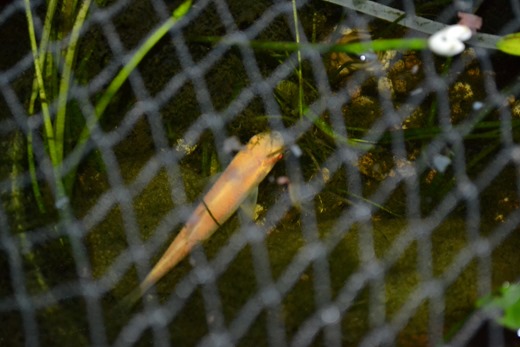
It has taken me several years to notice that my Orfe has got the most lovely blue eyes. I still am unsure whether ‘Goldy’ is a female or male fish. I think of it as a male as it appears to be in control of the pond. ‘He’ has the say when the rest of the fish move upwards to their food and if he holds back so do they. This fish is supposed to be a Golden Orfe but because of its colour I wonder if by chance it is a cross between a Golden and Blue Orfe. ‘He’ has jumped out of the pond on occasion and has luckily been found before any real harm came to him. This is despite a fine net being stretched across the pond to safeguard against herons and local cats. I still have not found out how exactly he has managed to escape the netting and find ‘himself’ thrashing about on the pebbled pathway surrounding his wet home.


old blue eyes

Golden Orfe with blue eyes

The Masons

Deep in the roots of mankind, embroiled in their history, secretive and seemingly solitary in their existence are the masons. It may be years before you come to recognise their presence but once you do and the spark ignites the fire of inquisitive yearnings of the desire to know more you will never turn away from them. This is such a lovely solitary saviour that you need to encourage.

We have both the Red Mason Bee (Osmia rufa) and the Blue Mason Bee (Osmia caerulescens) in our garden. We had an unusual Winter in that there was no snow just rain, plenty of water which led to an early Spring. This weather pattern appears to have confused all of the insects as they are all behaving quite differently to normal. We usually see the Red Mason Bee nest first, followed by the Blue Mason Bee and Leaf-cutter bee which usually build their nests in June. This year the Red Mason Bees arrived in late March. They were still squirrelling away at their nest sites, clearing out the chambers ready to lay this year’s eggs when they were met with the early arrival of both the Blue Mason Bees, and the slightly larger and perhaps a little more aggressive (at least when it comes to the arrangement of their nesting sites), Leaf-cutter bees. There are arguments breaking out constantly and I have never witnessed this pattern of behaviour before.

A new secret crusade trying to find enough laying space all in the same time frame and not over the several months which is the normal pattern of behaviour of these beautiful solitary bees.

Mason bees fighting for a place to lay their eggs

Red Mason Bee Osmia rufa and a Blue Mason Bee Osmia caerulescens

Mason bees fighting

A Red Mason Bee Osmia rufa chasing off a Blue Mason Bee Osmia caerulescens trying to prevent the use of a communal insect house in the holy grail quest of finding the perfect and safe place to lay this year’s eggs for the new brood.

I can almost smell Summer

I don’t know why but I have always loved how once April has arrived, so does a wealth of early flowers and the clouds of bloom on the fruit trees. One of my favourite tiny flowers that makes the pathways smell almost like ‘dolly mixtures,’ a sort of heady and very sugary sweet perfume, is Little Dorrit. Pretty, tiny four-petal parcels of syrupy florets which explodes with scent in every direction. They are a remarkable plant and will grow just about anywhere. Simply scatter the seeds wherever there is just a suggestion of a scrap or crumb of soil and they will sprout into the healthiest of plants within a few weeks. They self-seed so once you have them you have a flower-friend for life! 

Little Dorrit - Alyssum

Little Dorrit, Sweet Allysum, Alyssum maritimum, Lobularia maritima. This wonderful cottage garden plant is often called other names depending on which region of the world you are from. Other names include Alison, Allysum, Dorrit, Rockery Allysum, Sugar Allysum, House Maids ..

Little Dorrit - Alyssum, House Maids

If you look very closely you should be able to see an almost microscopic creature that is on one of the small petals.

Tadpole hatchlings–the first baby frogs are swimming

Some of the frogspawn in the pond has now developed into baby hatchlings (tiny tadpoles). All life from the egg to the new being is wondrous and amazing. So many variations and every one of them is just breath-taking.

tadpole

Tadpoles hatchlings circling the remainder of the frogspawn

Tadpole hatchlings

Tadpoles

Tadpoles hatchlings

The frogs in our area are extremely beautiful and very varied in colour and size. These are the first hatchlings (tadpoles) of the season of the Common Frog, often known as the European Common Frog, Rana temporaria. The tadpoles feed mainly as herbivores though when they are slightly larger they begin taking invertebrates ready for their final change into the parent frog.

The sun daisy

One of the most cheerful plants on the Earth is the humble sun daisy. It has edible leaves, roots and flowers and if you really look into its mane of petals has the power to improve the mood and bring cheer to the most grumpiest of persons. Today, the sun daisy opened her optimistic face in our garden border and here she is:

Dandelion 31.03.2014

Dandelion

A beautiful sun daisy, the dandelion, Taraxacum officinale, wild and wonderful and ever perennial

Jellied eggs

The frogs are singing at the moment. Every night their chorus, deep and loud, rings around the garden. A practising choir that alternates between bass and contralto, calls with an urgency. Their deep tuneful notes have proved very fruitful as the pond has been scattered in large dollops of beautiful jewels of frogspawn. The jellied eggs are currently resting on the pond netting and it is dipping deep under the waterline where the fish are hanging about like students waiting to be served in a 1950’s corner café.

frogspawn .. 16.03.2014

Frogspawn .. 16.03.2014 close-up

Frogspawn – picture taken 16.03.2014 at the garden pond

The weather is strange but a visitor has arrived

Although it's very windy and showery it is also quite warm for February and this has brought a hedgehog out from hibernation - looking for tasty treats. This one is tucking into cheese, cat nibbles, roasted peanuts in their shells and dates - (well it is Valentines evening, after all said and done).

What have you given your hedgehog to eat tonight?

Hedgehog

I wonder just how many hedgehogs and other wild life have been lost during this Winter period and it still isn’t over? One weather cycle after another with threat after threat to people and animals alike. No one and nothing is safe. It shows just how vulnerable and fleeting life can be and how everyone, everything and each second in time is more precious than any jewel that man has ever cast his eyes on. No one knows who will be affected next or which area will succumb to either floods, winds or snow and ice or maybe even something else…

Achieving tranquillity

Wherever a person may reside in the world, the one way to achieve everything of value in life, is to know tranquillity. True tranquillity comes from within. It is part of the soul.

The easiest way that an ordinary person can acquire tranquillity is to understand what makes them feel safe, contented and free. The best way I have found for this, which is surely the most valuable of jewels that a person can ever posses is to find a lovely little garden nook where I can sit and let the world go by. A place where you can hear a trickle of water, a wealth of bird song, scurry of little mammals, the hum and soft swirls of the insects, the sweet and gentle perfume of the flowers and herbs, the tickle of the breeze as it gently caresses your skin. A treasured small space of land where you are in a sense at one with everything. This is the place that heals your very core. It is what some call ‘The Holy Grail’ and it will serve you like the ‘fountain of youth.’

So, think what you most like. Which plants and flowers lift your spirit? What sculptures are enjoyable to look at? Treat yourself to the greatest diamond the Earth can produce a place where you can feel safe. A place to relax. A place to feel the love of life itself gently wrap around you. Find somewhere, either in your garden, back yard or not too far away for you to just enjoy breathing in and breathing out. We are after all living in Paradise!


Achieving Tranquillity Japanese Garden

Achieving Tranquillity River Garden

Achieving Tranquillity Sweet Garden

Achieving TranquillityWater Garden

Achieving Tranquillity Brook Garden

A few examples and aspects of gardens that ooze tranquillity above

The most essential and important thing to always remember is that your own ‘tranquillity garden or space’ must be a little bit of land that is what you find to be your own precious jewel and where you most feel at peace with the world.

Investment of flowers

I have decided to infuse the garden with many more flowers this year for two separate reasons. Firstly, I thought it would be lovely to see (hopefully) many more flowers than there have been in previous years. Secondly, I am hoping that new flowers will attract many more insects some of which could, if I’m lucky, be butterflies.

So far the flowers that I have chosen in my quest for improving the garden are: The Peace Poppy which are otherwise called Papaver Rheas Bridal White – this was a fairly common wild white poppy hundreds of years ago that is also the White Flanders Poppy and is recognised as a tribute to peace. Sadly, I can honestly declare that I have never seen one of these beautiful poppies either growing wild or even in a garden, nor is there another person I know who has witnessed the site of these pure symbols of joy growing where they belong. If I am successful then maybe a few will spread out away from my garden on the breeze to live in the open countryside once more. It would be certainly tempting to sprinkle a few seeds when I visit a new area of Worcestershire. (Perhaps we should all be tempted to grow a new wild flower each year in our gardens to help to re-introduce some of the old favourites that have been lost over time through previous generations carelessness.)

Amongst the flowers I am hoping will germinate is a biennial (these are planted one year to flower the following year – some, when a gardener is truly blessed even last a full five years before they die), a short stocky soft furry leafed foxglove called ‘Foxglove Silver Cub.’ To my new collection of plants to trial growing I have some seeds for Purple Creeping Thyme, Common Thyme, Bergamot, Ladybird Poppies Papaver Commutatum, Caucasian Scarlet Poppy, Peony Poppies Papaveer Paeoniflorum Huge Doubles Mixed Colours, and lastly some wild strawberries. This mix of varieties is to hopefully encourage more bees to visit daily. All I have to do now when the year warms up a little is to plant them and keep my fingers crossed that a small percentage of them will grow and form a lovely show of blooms. (They are all scatter seeds so need now expertise to grow – they just require planting after a shower of rain.) Always remember that anyone can grow poppies and foxgloves and they are the two flowers that enhance any little plot of land.

Flanders poppies - war and peace copy

The wild Flanders Field poppies red associated with remembrance of the fallen and white for the peace that has been so bravely fought for. It is important to grow both of these and appreciate what they stand for.


Bereft of birds

When I was a little girl, my father would take me on long walks down winding country lanes. Every so often he would stop and point to a tree and show me a bird and tell me its name. I would ask him how he knew that the tiny bird was there on the tree? He would simply say “I heard it singing!” I was both enthralled and captivated – it was like a magic trick – to hear a bird, know which branch of what tree it perched upon and to be able to name it too all from its burst of song. My father taught me to love all creatures, to watch them and treasure them and to know that it is a gift to both hear them and see them.

It is now January of a new year but this year we are bereft of birds. Gone are the vast numbers of sparrows and starlings. Gone are the garden visitors the cheeky finches and the sweet tits. Every garden should have its own blackbird and robin, these are both territorial birds and they are noisy in their declarations of which gardens they have chosen to be their homes. Where has our blackbird and robin gone? Not a sign of either bird in this dawn of a new year can be seen.

We have one or two crows, an odd magpie, wood pigeon and ring neck dove. All of these are considered to be large birds. It is worrying to consider that none of the small and medium birds appear to be around. The fat balls hang like remnants from a bygone time in a museum. Even the squirrels have left the nuts alone and the bird seeds have begun to sprout!

Crow

Our Carrion Crow - Corvus corone (note the crows in our area often have a little bit of white on their tail or wing feathers) .. you may just about be able to see the lighter spot on this one’s tail feathers.

Pet garden statue

Years ago the only statues available for the average family garden were gnomes. The name given to the little pixies that are said to protect the area of land where you plant and toil with love and joy, your garden, is gnome. GNOME means ‘guarding naturally over Mother Earth.’ Although no garden is really safe without their own special gnome it is also nice to have a few other garden statues to add your own special character to the little plot of soil where you spend so much time making it look so beautiful.

I have a couple of gnomes – nothing special but they watch over my work. Suddenly I felt it would be lovely to introduce a new statue. As yet that very special statue has not been found but whilst I’ve been looking I found what is often called a garden pet statue and I thought it looked so realistic that it would be a lovely small addition to the flower border. So here is a picture of it the ‘pet garden tortoise statue.’

Pet tortoise garden statue Pet statue tortoise

Tortoise statue  Tortoise and bees

Garden statue of a tortoise

Why we should all have a statue of a garden gnome – because of its wonderful meaning: it is a guardian of the garden as the word GNOME means ‘guarding naturally over Mother Earth.’

English fairies of the garden

The beautiful Large White butterfly, which is generally known as the ‘Cabbage White’ butterfly flutters in such a way that it resembles a fairy and so is sometimes called the English fairy. Both the Large White and the Small White, which generally dominate the butterfly scene of the early warm days in Spring were very sparse this year. So late did they make their entrance that they are still hatching and there are now caterpillars that appear to be transfixed in a perpetual state and unable to develop into a chrysalis.

Caterpillar of the Large White Butterfly - Pieris brassicae Caterpillar of the Large White Butterfly - Pieris brassicae - close-up Catterpillar of the Cabbage White - Large White - English Fairy - Pieris brassicae

The Caterpillar - Pieris brassicae - of the Large White - Cabbage White - English Fairy Butterfly  The Caterpillar of The Large White Butterfly - The Cabbage White Butterfly - The English Fairy Butterfly -

The Caterpillar of The Large White Butterfly, The Cabbage White Butterfly, English Fairy - Pieris brassicae

The caterpillar on the leaf above has now not moved for three whole days!

The meat in your fruit

Watch out those of you who are vegetarians or vegans because there is meat all around! The raspberry season has been spectacular this year and this particular droop is exceeding its lowly cousin the blackberry by a mile. Not only are the raspberry fruits plentiful but they are large, sweet and juicy also. I have been picking a fair few each time I have ventured into the garden and squelched their freshness onto my tongue whilst their pips have juicily jumped down my throat like miniature pomegranate pips. However, recently I nearly got caught out by a tiny green meaty fellow that was so tiny I was only awakened by what appeared to be a little green hair that momentarily seemed to be moving. On closer inspection there was a tiny hair-like worm which I think may have been a newly hatched raspberry beetle in its first stage of life.

Raspberry droop inner caterpillar with silk spin

Raspberry droop inner caterpillar with silk spinning

Raspberry droop inner

Raspberry droop close-up picture

Raspberry droop close-up of the flesh with strand 3

Raspberry droop close-up picture of strand coming from one of the droop fruit seeds

Raspberry caterpillar spinning silk

Raspberry beetle grub Byturus tomentosus, weaving silk in the centre of a raspberry droop

Close-up pictures of my raspberry, together with its newly hatched grub; pictures of the tiny green hairs that grow between the tiny fruit seeds

Cape Fuchsias – Phygelius – tall, hardy and very regal

The soldiers of the African garden, Cape Fuchsias grow well in British soil. I have only encountered two hybrids available for purchase, a deep Royal Pink and a warm Emperor Orange. Wild Cape Fuchsias all have delightful yellow throats but are inclined to grow between a metre to a metre and a half in height with a spread of around eighty centimetres.

I purchased mine a couple of years ago as tender, small, young plants and with a little fertilizer and a splash of water they soon began to grow. I was pleased that they established themselves so well in our soil.

Cape Fuchsias, unlike other hardy fuchsias, are not non-stop flowering plants throughout the Summer. They have a flowering season then have to be gently pruned back and nurtured with some more plant food before they provide a second show of flowers. They do provide vivid splashes of brightness so are well worth adding to the border. Do not buy too many as they are easy plants to create off-spring from. The two best ways for cultivation are firstly by seed collection – keep the seeds in the house or a warm greenhouse and store in dry conditions. An old clean brown paper bag stores most seeds well. Plant the seeds outdoors from mid-March onwards preferably in an area of the garden that faces the sun. Make a small dip or drill into the soil the size of a bamboo cane placed on its side – drop the seeds in the row and roughly cover with earth – water evenly with a gentle spray. If too many seedlings germinate take out the weak ones and allow the strong ones to form new plants. The other method is to gently pull away some of the soil around the root of the plant and you should see quite sturdy sucker type root stems just underneath the surface. Pull one of these slightly above the surface and push a dry twig underneath the exposed area. You should find that a small stem with leaves will grow and once it has reached the height of a hand approximately 16 to 18 centimetres. Gently prize out the new plant and cut through the attached sucker root. This may now either be planted on into a medium to large flowerpot or tub or into a sunny place in the garden border.


Cape fuchsias - African Soldiers

Cape fuchsia - Phygelius - pretty hybrid

Cape fuchsia - Latin name Phygelius

Cape fuchsia - Phygelius

Cape Fuchsia – African Soldiers - Phygelius

Houses to let

Houses this year are very popular. Both the Mason and the Leaf-cutter bees have practically filled up all of the vacancies and there have been very few homes left empty and as yet, apart from some being obviously too narrow or too wide, I have not been able to find out why the remaining homes, which look perfect from the outside are left and not taken up some years.

The bees appeared to be keener than ever this year to increase their numbers and they moved with amazing alacrity to fill as many suitable crevices within both the wooden Insect tenements. First the Mason bees had their pick and packed the tube houses with mud – then just before they had finished possessing as many properties as they were able, the slightly larger Leaf-cutter bees shook themselves about and proceeded to claim all of the remaining suitable vacancies. Never have I seen such an array of colours and materials being stuffed into the entrances to make the front doors secure.

Busy bee working hard on her new house This shows one of the larger Leaf-cutter bees scraping around the edge of the bamboo making sure that it is spick and span before sorting it out as a suitable nesting home


The insect house 2013


Houses to let

This shows the variety of materials used to seal the front doors of each of the compartments. You can see the mud or clay used by the Mason bees as well as the large variety and colours of the leaves used by the Leaf-cutter bees.

Jungle jewel weaves magical tentacles creating a perfect paradise

I must admit that as the Spring rolled out in front of me I thought that I had lost all of last years’ perennial garden purchases including the Everlasting Sweet Pea or Perennial Sweet Pea as it is often called. It was late rising from the ground and despite searching and searching there was no sign of any green shoots in the place where I planted out my plants. Then one day I noticed a leaf and a tendril that was pea shaped. After just a few weeks more this wonderful plant surprised me with the speed that it grew. It hangs on the branches of the apple trees pushing itself higher and higher. I am so pleased that I have it in the garden. Its flowers are not strong in perfume, in fact, their scent is so mild that you need a good nose to find it. It rewards with so many stems, each holding perfect jewels and just two or three make an excellent posy.

Although it is known as a European plant its popularity has spread throughout many countries. It produces pods of seeds once the flowers are spent and I will be tempted to grow a few more of these beautiful plants. They are also known for occasionally self-seeding creating new plants around the original parent plant. Once the plants have established themselves it will also be possible to split them taking a portion from the root and making a new plant for another area of the garden.

Everlasting Sweet Pea - Perennial Sweet Pea - Lathyrus latifolius 2

Everlasting Sweet Pea - Perennial Sweet Pea - Lathyrus latifolius

 Everlasting Sweet Pea - Perennial Sweet Pea - Lathyrus latifolius

Everlasting Sweet Pea - Perennial Sweet Pea - Lathyrus latifolius 3

 Everlasting Sweet Pea - Perennial Sweet Pea - Lathyrus latifolius (this picture taken in the late evening)

Albino fish

It was time to add a couple of new fish to the garden pond. We had sadly lost two of our Golden Orfe during one of the several hot periods of the Summer. The heat sucks out the oxygen and leaves the fish gasping. We thought that with all of the oxygenating weed,the filters, a UV box and fountain on for most of the day that the pond was healthy enough to protect the fish and wildlife when the temperature soared. Sadly, although we never actually saw any of the fish gasping at the surface, we now know that the reason we lost the two Orfe was through lack of oxygen in the pond water. Since then we have added a fizzer/bubbler and have run several pipes off it to keep the water moving and provide oxygen bubbles in their thousands for our merry shoal of fish.

When we went into the aquatics centre, besides the goldfish, comets, shubunkins and koi they had Albino Grass Carp with pale skin and pink/red eyes. Although these pale carp were only very small, they appeared to be drawn to everyone as they passed by. I stopped and peered into their tank and immediately a third of all of the masses of fish swam towards where I stood. I then placed my hand just above the water and before I had chance to pull my hand back several jumped up out of the water and kissed my finger tips. I have never seen fish so very, very friendly before. Up and up they jumped and sucked at my fingers. My heart had been captured and so I now have two Albino Grass Carp.

I wondered what I should name them. After a while I decided upon two children’s comic names. So for their friendliness and cheekiness I thought the names Dandy and Beano suited them nicely.

I have hurriedly taken some pictures of them. One day time view which doesn’t do them justice at all and some taken as soon as it became coal black outside and here they are:

Albino grass carp - young fish

 Baby Albino Grass Carp – picture taken during daylight hours with protective netting to keep off the herons

Albino grass carp - picture taken at night

Albino grass carp - picture taken late at night

Albino grass carp - pictured at night

Albino grass carp - eyes light up during night time picture taking

Albino Grass Carp - Ctenopharyngodon idella - taken when it was pitch black – the light from the camera’s flash is picked up on the red eye of one of the fish in the bottom picture

Grass Carp are herbivores and are a useful fish to have in ponds, lakes and rivers as they help to keep water weeds and side growing algae under control