Random Ramblings

Random Ramblings: Personal observations on a wide variety of subjects. Photographs of creatures and things that are taken on seeing the unusual as well as everyday things.

Dental floss

Dental floss is dangerous! Leading me to ask the question ‘Who needs Botox?’

A couple of days ago I accidentally nicked the corner of my mouth with a length of dental floss. I finished cleaning my teeth and went to bed. When I awoke the next morning my lips had swollen and puffed out … to say the very least it was uncomfortable and left them feeling sore … So far the ‘Botox’ look has lasted three whole days and I am quite fed-up with plastering them with Vaseline to protect them.

Dental floss

Years ago before dental floss was invented, I used a length of cotton or thread to clean between my teeth.


Country Quips:

    • If you only have your looks to trade on, your trade will be very short lived!

The hump

My mother often told me that we all occasionally have ‘off’ days. Days, when we feel something – we cannot necessarily put our finger on it – but something is making us out of step with the world. For no reason that we can think of, we especially when children, become mardy. I was a very lucky child as I was usually light in spirit, laughed at the clouds and ran with the wind. Sometimes ‘the hump’ would reach out, slap me down and suck me up. It was on occasions like this that my mother would take me up and hold me tightly in her arms and recite straight out of her head, Rudyard Kipling to me. I’m not sure when she was taught it, or quite how she remembered it, but she managed to convey every syllable to me in a lovely motherly way and I always felt so much better after she said it, as it brought back the sunshine and the giggles … It should always be remembered that a little industry in the garden brings out the angel and pushes the devil away! If you have never read any Kipling before then this little poem should make you an ardent fan for it shows he knows his fellow man better than most:

The Camel's hump is an ugly lump
Which well you may see at the Zoo;
But uglier yet is the hump we get
From having too little to do.


Kiddies and grown-ups too-oo-oo,
If we haven't enough to do-oo-oo,
We get the hump-
Cameelious hump-
The hump that is black and blue!

 
We climb out of bed with a frouzly head,
And a snarly-yarly voice.
We shiver and scowl and we grunt and we growl
At our bath and our boots and our toys;

 
And there ought to be a corner for me
(And I know' there is one for you)
When we get the hump-
Cameelious hump-
The hump that is black and blue!

 
The cure for this ill is not to sit still,
Or frowst with a book by the fire;
But to take a large hoe and a shovel also,
And dig till you gently perspire;


And then you will find that the sun and the wind,
And the Djinn of the Garden too,
Have lifted the hump-
The horrible hump-
The hump that is black and blue!

 
I get it as well as you-oo-oo-
If I haven't enough to do-oo-oo!
We all get hump-
Cameelious hump-
Kiddies and grown-ups too!


The birds have kindly scattered some of their bird food around the garden and this is one of the flowers that has grown from their stray peckings – a beautiful sunflower. If you look closely you can see that a sunflower is in fact many tiny flowers gathered together in a head and adorned with a halo of golden petals.

Sunflower

Centre of the sunflower or helianthus

Bring back the sleeves

Year-after-year-after-year-after year fashion designers are leading women by the noses and taking the easy way out. For goodness sake I cannot be the only female on the planet who is fed up of seeing sleeveless dresses in every shop. Added to this, these flimsy frocks are offered only in two lengths … down to the floor like widow’s weeds or up to the thigh like a brothel’s uniform.

Where have all the T-dresses gone? We are constantly being told to cover up and protect our shoulders and tops of our arms and would like to do so whilst looking a little feminine so … designers/creators of fashion – please, please, please, please design something wearable for women. There is plenty of stuff out there for young girls in their teen and twenties …

I support the campaign … BRING BACK SLEEVES IN DRESSES .. do you? If you do please Blog/Tweet/Facebook something to spur the movement on.

Bring-back-sleeves symbol

Magpie meal

It is something that most people love to see, birds … in their garden or outside their windows. I was pottering at the back of the garage and happened to glance out of the window. On the lawn, two magpies were busy poking their long beaks deep into the soil. They appeared to be imitating blackbirds, who regularly dip their beaks down into the soil of the lawn and pull out fat, juicy worms or grubs. I have never seen magpies search for meat this way before. Eventually, one of them hopped onto the seat of a wooden garden chair. The other magpie, jumped onto the plank of wood forming the cross piece of the chair below. The one on the seat poked its beak through the wooden slots, whilst the one beneath positioned itself directly under the bird above and began to take something out of its beak.

Magpies, appear to be mimicking other birds behaviour – no wonder they are growing in numbers and are probably now one of the most successful birds in the Midlands.

Next time that you see a magpie, take a long, careful look at it and you will not only see a bird of the future as it changes with the times – you will also see something of the creature of its past. As it walks with a purpose, sucking in its surroundings with its eyes – there is something of the dinosaur, alert and alive still within its core … biding its time and waiting for its chance to perform on the world stage of life.

Miagpie eating at the bird table

Magpie eating at the bird table

Plop in the pail

Over the years I have read many things regarding the attributes of water. Something that I read fairly recently has stuck in my mind and perhaps it’s time to share it.


Water droplet

Water is like medicine to the body, especially the heart … water helps to activate all of the body’s organs when drunk first thing in the morning. Water helps the heart and all the other organs to work more efficiently if consumed at regular intervals during the day. Water helps to protect the body from both heart attacks and strokes if drunk just before bedtime. Just one little extra note … water helps the brain to work more efficiently.

Now … go and get a glass of water and remember to sip it often it is probably the best medicine that you will ever take in your life.

Water droplet

There are many thoughts as to the quantity we should consume every day but many doctors advise around two litres.

Water droplet

Little extra fun notes on the wonders of water …

Water gives you a flat tummy

Water stops water retention and bloating

Lets be full

The Leaf-cutter bees have been busy. This year they appear to be using leaves from the raspberry canes and a particular fuchsia that seems to be a favourite flavour, a very hardy perennial, gold-leaf variety called Genii. What posh little apartments they are making for their off-spring! The bees are filling up both insect homes … the established old version and the new pyramid shaped one.Leaf-cutter bee homes


Leaf-cutter bee plugging

The Leaf-cutter bees are making quick progress in filling up the bamboo canes with their off-spring

Plodding the beat

It’s amazing how many different pieces of information a person can acquire in day-to-day routine. Sometimes a person can obtain a useful piece of a puzzle to help solve a problem. Occasionally answers to unasked questions just hang in the air. Every so often a gem of knowledge passes into the ear and gets tucked away into a corner of the brain until it is required to solve a mystery.

It came to pass that one day whilst standing in one of those queues that never appears to move, I struck up a conversation with a lady behind me. She revealed that the previous year she had developed palpitations, a sort of pounding with occasional flutters in the heart. She said that she had been advised that it was caused by stress but nothing she could do appeared to help the situation. Then one day she had a chance meeting with an old gypsy lady. As she had with me, she also told the gypsy about her problem. She told me that the elderly gypsy took her hands and looked at the palms. She pressed the palms with her thumbs then declared ‘Your problem is shortage of sugar!’ Sure enough the woman went back home and swallowed a teaspoonful of sugar as the old gypsy lady had advised … one every morning and one late afternoon. The woman told me that after four days she was cured and had never been troubled with palpitations since. ‘Surely, I said to her sugar is bad for you. Everyone tells you to cut it out of your diet.’ ‘I know,’ she said ‘but it truly did the trick. I cannot explain why but was so grateful that I tried it.’

Heart - pounding the beat

This, I hasten to add is a hearsay cure for this stress type condition. I cannot vouch for it but it is one of those conversations that has always stuck in my head!

Please remember, it is always best to consult a medical practitioner rather than self-diagnose any kind of condition and follow very carefully your doctor’s advice.

I spy sleepy July

There is something slow, sleepy and narcotic about the month of July. Full of creeping, caressing plants that grow slowly as you watch them winding and binding themselves onto other plants, up trellis and trunks, up styles and gates. Pinning themselves with glue-like ferocity to walls, stones, ledges and pathways. Yet, time is beautiful in this soft, sweet place where insects gently hum and birds call with notes of pure shrill tones and water gurgles and bubbles over stones. It is surely the month of the gods, for anyone descending onto our rough diamond home from far away would want to wallow and roll in its pure beauty. To suck in the warm sweetness of angels breath and become high with expectations of the gluttony of so much colour and sound .. we are surely in Heaven!

Honeysuckle windings

Honeysuckle July windings

Twin flowering honeysuckle on the climb

Winding and binding Tufted vetch - Vicia cracca - grows up to 200 cm in height or length

Winding binding Tufted vetch in July – Vicia cracca, grows up to 200 cm in length and is a member of the pea family

Thirteen

The cat has turned thirteen. She is doing remarkably well. We obtained her as a four month old kitten from an animal rescue centre and had been advised that she was the runt of the litter of a very young female cat of under a year old, who was herself considered to be only a kitten. All of the other brothers and sisters of the litter had died with the exception of our little runt. She was the only black and white kitten at the rescue centre. She looked so very long and thin and we were told she would never be a large cat. Here we are all these years later with a very pretty queen, supporting long, lustrous whiskers. Her eyes are bright and there are times when we see the lion in her actions and personality. She guards our garden both front and back, the drive and the nearby houses, which are all her territory. How dare any other feline put their paws anywhere on what she considers to be her land? She slaps any cat who tries to encroach on her territory on the behind with a multi-pat of paws like an animal from a pride. Strangely, I have seen male cats twice her size cower and flee at speed – and yet she is not at all nasty. She is full of purrs and rubs and loving …

Thirteen

Pyramid selling

I have been looking for quite a long time to see if I could find an addition to the little garden home that has brought me so much pleasure and entertainment since it was attached onto my small shed. I thought about having a go at reproducing my own version but fate was kind to me and presented me with a very practical, durable and economical answer the other day – a pyramid insect dwelling.

Pyramid insect dwelling place

Pyramid insect dwelling place

The Leaf-cutter bees have been back cleaning up the tubes of bamboo in the original insect house for a week or so. The protracted Winter weather had battered and bashed my original little insect house so much that after discussion we decided to take it down, do a quick repair and splash a little wood preserver on the top and sides. The bees were furiously buzzing around the holes and those that were away collecting leaf circles returned laden and very puzzled as to where their house had disappeared to. After a short while we placed the old insect house on the right-hand side nearest the fence and the new one was positioned where the old one had stood for the past four years.

The bees soon settled down carrying on with their mission but quite unexpectedly one of the larger bees and a couple of others broke away and began to take up residence in the new pyramid home. Now both insect houses are being filled …

Insect houses

The new and the old – home of the Leaf-cutter bees

Pyramid for Leaf-cutter bees


24th, inexplicabilities

Midsummer slowly gambols its way into the month of June. It is like a wraith, a ghost, a magical creature that swirls itself into every nook and cranny. It presents itself in unexpected places and as much as people have tried, over the centuries, to explain it the only answer ever offered from the wisest and knowledgeable to the eccentric and slightly touched is ‘it is the faery folk.’

Much as we like to scoff and pretend that this is an ordinary time in an ordinary month we are always proved wrong.

This morning, I awoke to a pond that had suddenly plummeted in its water depth. Yesterday it was almost to the very brim with everything freshened and re-born in the recent rainfall. Now it reminds me of the sea shore when the tide goes out.

Midsummer pond drop Midsummer’s day water pond drop

My beautiful snow white floribunda Iceberg roses have suddenly changed into blood spotted nightmarish versions of the usual perfection.

Snow white floribunda Iceberg rose on Midsummer's day

Floribunda Iceberg rose on Midsummer's day

Up above my Iceberg rose on Midsummer’s day with its pink and blood red spots and stripes

Iceberg climbing

Iceberg rose … what it usually looks like

My Goji berry bushes have developed a Midsummer plume of mildew.

Goji bush midsummer mildew

Midsummer Goji berry bush sprinkled with mildew

Of course, there are rational explanations as to why these things happen all around the same time in the middle of Summer, after all we all know that it isn’t the fairies, pixies and goblins … don’t we?


Lazy daisy

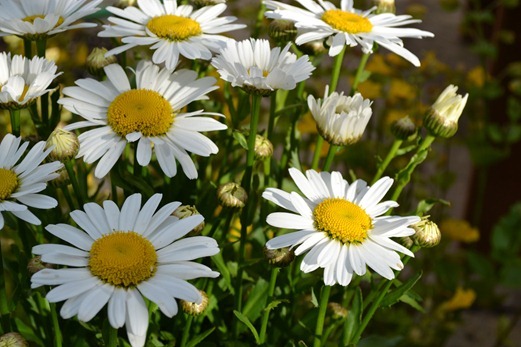
A large proportion of flowers in the world are part of the daisy family. From early childhood, the daisy brings us something that is difficult to define other than perhaps a familiar, friendly reassurance with its bright, gay, smiling countenance. The daisy, in one of its many forms, is essential as part of the garden family. It is, however, one of the most difficult plants to acquire – at least in the regular common ‘dog daisy’ form. Nurseries and Garden Centres are seemingly bereft of the bright yellow eye trimmed with a wheel of sparkling white eyelashes of the common form of garden daisy. This is the ‘old fashioned’ variety that everyone’s Great Great Grandmothers had dancing below their windows that neither frost or draught could ever kill off.

The origin of the name daisy, at least in the English language most likely arose from two early Anglo Saxon words ‘daes eage’ which translates into ‘day’s eye.’ People would notice how the daisy flowers would close up their petals tightly when twilight fell only to open them the following day just as dawn arose.

When a person gives a person either a daisy, a bunch of daisies or a daisy plant it holds special meanings … new beginnings, loyalty, purity, trust and dependability. This is probably the reason why years ago many brides chose daisies for a wedding posy as they instantly showed her intensions of becoming a good wife.

Cottage garden - Dog daisy

Cottage garden – Dog daisy

The Cottage Garden Dog Daisy

The Dog daisy

The Dog daisy … common Cottage garden daisy

My original daisy, which was a dwarf variety died off during the long very cold Winter that we had. After searching and searching I came across the above daisy which I am hoping is a traditional ‘Dog daisy,’ this week. I purchased two out of the remaining four plants which sat on the shop shelves and now I have my fingers well and truly crossed hoping that this is indeed the sturdy, hardy, traditional daisy that withstands everything that Nature can throw at it! Only time will tell but optimistically I am calling it ‘Dog daisy’ after the daisy that dwelt in my mother’s garden for well over forty years and for all I know is residing there still.

Strife

There is nothing quite like tall, elegant border plants to attract the bees. I have had Purple Loosestrife in my garden for years but this year one plant has changed into a beautiful champagne pink … it began to toast the bees as soon as the flowers opened. I have neither heard of nor seen this colour variation before and wonder whether it could be a new variety that nature has suddenly presented me with.

There are a few types of Loosestrife, those that belong to the Loosestrife family and those that belong to the Primrose family. Loosestrife, the purple variety is known as Lythrum salicaria. If mine, is in fact a new variety then I shall name it Lythrum pollykloggers. Lythrum means loostrife and of course pollykloggers would indicate the new variety.

I think it is very pretty …

Champaigne pink - Loosestrife

Loosestrife - Lythrum pollykloggers - champagne pink

Loosestrife - Lythrum pollykloggers - champagne pink with bee

Champaigne pink - Loosestrife - with bee

New variety of Loosestrife - champagne pink

Loosestrife – champagne pink … (possibly a new variety and if it is then I shall name it: Lythrum pollykloggers)

Lunar

Last night there was a lunar eclipse and in many areas of the world a deep red alien moon, peered down upon the Earth. Here in Worcestershire our sky was covered in cloud … our moon wasn’t even ‘tossed upon cloudy seas!’

Lunar eclipse

It will be December before having the chance at such a moon gaze once again.

Potted ladybird

Ladybirds are probably the only beetle that children instantly fall in love with. Avidly pursued on flowers and leaves and gently placing tips of fingers up to the fronts of this lovely spotted beetle to have it race up hands and onto arms. Feeling the pitter-patter of tiny, tickling black feet which brings out squeals of joy just as it has done for generation after generation. So with such nostalgia how could I resist the temptation of a pottery ladybird?

Potted ladybird

Potted ladybird