Random Ramblings

Random Ramblings: Personal observations on a wide variety of subjects. Photographs of creatures and things that are taken on seeing the unusual as well as everyday things.
Showing posts with label Nature. Show all posts

Old blue eyes

It has taken me several years to notice that my Orfe has got the most lovely blue eyes. I still am unsure whether ‘Goldy’ is a female or male fish. I think of it as a male as it appears to be in control of the pond. ‘He’ has the say when the rest of the fish move upwards to their food and if he holds back so do they. This fish is supposed to be a Golden Orfe but because of its colour I wonder if by chance it is a cross between a Golden and Blue Orfe. ‘He’ has jumped out of the pond on occasion and has luckily been found before any real harm came to him. This is despite a fine net being stretched across the pond to safeguard against herons and local cats. I still have not found out how exactly he has managed to escape the netting and find ‘himself’ thrashing about on the pebbled pathway surrounding his wet home.


old blue eyes

Golden Orfe with blue eyes

What a very busy few weeks ..

Last year my patience was like a soft rubber band, ever stretching, becoming longer and longer. My wonderful bee NUC was delayed owing to a dreadfully long Winter spell and a damp and inclement Spring that extended itself well into a third of the year. Every book, every article I had read advised that a late brood of bees would not come close to swarming the year after receipt. I was therefore unprepared when my little colony exploded with growth and virtually tumbled out of the hive.

First course of action is apparently to checkerboard the main brood box. This meant the use of a second brood box. Half the colony was placed in the second brood box and new frames and wax were place in between on both brood compartments. I hadn’t the time to purchase a complete new hive and so the second box was placed above the three supers on the original hive. A new entrance was made by pulling back the mesh. Another entrance was also created in the supers. This action, I thought would be enough but the following week during inspection the queen had obviously lost a considerable amount of weight. Oh no! That must be a bad sign, I thought. And, of course, it was.

Bee - two brood boxes plus supers

Measures to prevent the swarming of honey bees – splitting the colony and checkerboarding the brood box

The Masons

Deep in the roots of mankind, embroiled in their history, secretive and seemingly solitary in their existence are the masons. It may be years before you come to recognise their presence but once you do and the spark ignites the fire of inquisitive yearnings of the desire to know more you will never turn away from them. This is such a lovely solitary saviour that you need to encourage.

We have both the Red Mason Bee (Osmia rufa) and the Blue Mason Bee (Osmia caerulescens) in our garden. We had an unusual Winter in that there was no snow just rain, plenty of water which led to an early Spring. This weather pattern appears to have confused all of the insects as they are all behaving quite differently to normal. We usually see the Red Mason Bee nest first, followed by the Blue Mason Bee and Leaf-cutter bee which usually build their nests in June. This year the Red Mason Bees arrived in late March. They were still squirrelling away at their nest sites, clearing out the chambers ready to lay this year’s eggs when they were met with the early arrival of both the Blue Mason Bees, and the slightly larger and perhaps a little more aggressive (at least when it comes to the arrangement of their nesting sites), Leaf-cutter bees. There are arguments breaking out constantly and I have never witnessed this pattern of behaviour before.

A new secret crusade trying to find enough laying space all in the same time frame and not over the several months which is the normal pattern of behaviour of these beautiful solitary bees.

Mason bees fighting for a place to lay their eggs

Red Mason Bee Osmia rufa and a Blue Mason Bee Osmia caerulescens

Mason bees fighting

A Red Mason Bee Osmia rufa chasing off a Blue Mason Bee Osmia caerulescens trying to prevent the use of a communal insect house in the holy grail quest of finding the perfect and safe place to lay this year’s eggs for the new brood.

The Moon

Where would we be without the Moon? It lights our way on dark nights, pulls at the waves and creates the tides, encourages plants to grow, in fact it rules our very lives. The Moon is gradually leaving the Earth and one day our planet will have no Moon. It will take a very long time before this happens but when it does, the people who are living on our planet will have a very different life to that which we live today. Imagine a sea without any tides, without any waves! We have been brought up with a Moon. It is there and it is familiar; it is part of our lives and although we may not realise it we all have an affection for the ball of rock that rolls across our sky.

Sharing some pictures that I have taken of our wonderful, dusty, rocky Moon – carry on rolling for us all to look at!

The Moon by Day


The Moon by Day 2

I can almost smell Summer

I don’t know why but I have always loved how once April has arrived, so does a wealth of early flowers and the clouds of bloom on the fruit trees. One of my favourite tiny flowers that makes the pathways smell almost like ‘dolly mixtures,’ a sort of heady and very sugary sweet perfume, is Little Dorrit. Pretty, tiny four-petal parcels of syrupy florets which explodes with scent in every direction. They are a remarkable plant and will grow just about anywhere. Simply scatter the seeds wherever there is just a suggestion of a scrap or crumb of soil and they will sprout into the healthiest of plants within a few weeks. They self-seed so once you have them you have a flower-friend for life! 

Little Dorrit - Alyssum

Little Dorrit, Sweet Allysum, Alyssum maritimum, Lobularia maritima. This wonderful cottage garden plant is often called other names depending on which region of the world you are from. Other names include Alison, Allysum, Dorrit, Rockery Allysum, Sugar Allysum, House Maids ..

Little Dorrit - Alyssum, House Maids

If you look very closely you should be able to see an almost microscopic creature that is on one of the small petals.

Bee embryo

Although being an insect bees do not have a form of embryo like those in mammals, they do have a stage betwixt the egg and the grub which is the nearest the insect world has to the embryo. I was very fortunate when I was able to capture this stage of bee development.

Bee embryo

Bee embryo (the stage between the egg and the grub)


Bee embryo - small picture

First stage of the honey bee grub


Honey bee eggs - first stage of life

Honey bee eggs laid in the wax cells of the comb

Tadpole hatchlings–the first baby frogs are swimming

Some of the frogspawn in the pond has now developed into baby hatchlings (tiny tadpoles). All life from the egg to the new being is wondrous and amazing. So many variations and every one of them is just breath-taking.

tadpole

Tadpoles hatchlings circling the remainder of the frogspawn

Tadpole hatchlings

Tadpoles

Tadpoles hatchlings

The frogs in our area are extremely beautiful and very varied in colour and size. These are the first hatchlings (tadpoles) of the season of the Common Frog, often known as the European Common Frog, Rana temporaria. The tadpoles feed mainly as herbivores though when they are slightly larger they begin taking invertebrates ready for their final change into the parent frog.

The sun daisy

One of the most cheerful plants on the Earth is the humble sun daisy. It has edible leaves, roots and flowers and if you really look into its mane of petals has the power to improve the mood and bring cheer to the most grumpiest of persons. Today, the sun daisy opened her optimistic face in our garden border and here she is:

Dandelion 31.03.2014

Dandelion

A beautiful sun daisy, the dandelion, Taraxacum officinale, wild and wonderful and ever perennial

Bee eggs–honey bee first lay

The warmer spell of Spring weather has energised the honey bees and the Queen has begun laying new brood in earnest. Here are two of her eggs. It is the first time that I have seen bee eggs and I don’t know why but I found their shape and tiny size quite surprising.


Honey bee eggs

Buckfast honey bee eggs, just laid

Faux hemp–a cautionary tale

A couple of years ago, whether you picked up a newspaper, magazine, health book, etc it seemed the whole world was recommending the health benefits of hemp oil and hemp seeds. I bought into this notion as well. We are all wanting when it comes to bountiful good health and life giving treasures.

I was shopping one day when I came across some of these ‘health-giving’ hemp seeds – they were hard and full (obviously packed full of their precious oil and nutrients). Some even labelled them as ‘seeds of gold’ so how could I go wrong. All I needed to do according to article after article was to crush them, perhaps with a food processor or coffee grinder, the helpful articles indicated.

Well I got my precious hemp seeds home and I tried grinding them up .. but they felt like crushed gravel, really brittle and hard. Could I really risk sprinkling them onto my breakfast or lunch? What about my teeth? The thought of cracked teeth and tooth crumbs immediately took away their health giving properties. So I put them at the back of the cupboard and forgot about them.

Last year when cleaning out the cupboard I came across them and thought to myself that I might as well throw them outside for the birds to eat. One sprouted and before I knew it began to grow. It was bound to die for the weather had turned quite chilly. It didn’t die and the other day I noticed that it was flowering. These were not hemp flowers though. So my healthy hemp seeds were not hemp seeds at all. When I realised what they were I was really thankful that I hadn’t eaten any because these were the seeds of a deadly poisonous plant!

The plant that I am referring to and came from the seed which I purchased is called a Stinking Hellebore. It is also known as Bear’s Foot and Dung Wart. It’s Latin name is: Helleborus Foetidus.

Yeasts are attracted to the plant which linger around its flower heads and helps to raise its temperature. Perhaps this is what increases its poisonous properties. It is one of those plants that require instant hand washing after touching because it leads to volatile bouts of sickness and violent and projectile vomiting and delirium.. so best enjoyed at a distance!

Helleborus Foetidus 1

Helleborus Foetidus 2

Helleborus Foetidus 3

Helleborus Foetidus 5

Helleborus Foetidus 6

Stinking Hellebore - Helleborus Foetidus – Bear’s Foot or Dung Wart


Pet bees

It is surprising just how easily a person becomes quite attached to their honey bees. I wouldn’t have thought it possible but once the bees are established and you get over the initial wariness of the possibility of getting stung then you experience the pleasure of entering the wonderful world of the insect.

I have always loved honey and usually have a little every single day, so whether my skin oozes a small amount of its smell or not I am unsure. What I do know is that the beautiful lady worker bees land on my skin and dip their tongues onto it and appear to lick me. This tickles just a little but after a short while they take off and go about their business. They do appear to like strolling about on bare skin. The variety of these bees is called Buckfast. They are noted for their gentleness and their ease of establishing themselves in the average garden.

When they leave the hive, they do not fly straight across the garden but always go upwards and then choose a particular direction that they wish to take. So they are up and away from both yourself and your neighbours. As with any other pet you must make sure that you supply fresh water for your bees. This is often best placed into a bird bath or earthenware dish that is filled with large pebbles before adding any water. This ensures that the bees are able to drink without drowning. The next important thing to remember is that there are no flowers during the early part of the year and unless you know that your bees have ample honey stores to eat then you do need to feed them. They do fairly well on inverted sugar syrup and honey which you can easily make yourself.

Basic recipes involve white cane sugar, water, a small squirt of freshly squeezed orange or lemon juice and a pinch of food grade citric acid. It is the orange, lemon and/or citric acid which inverts the sugar mixture and this helps the bees to digest it easily. In real emergencies then sugar may be given straight from the packet – it is better to feed instantly than leave the bees to starve.

Buckfast worker bee face

Buckfast worker bees March

Buckfast honey bees

Our beautiful lady Buckfast honey bees

Award and front page from Pixabay

Although I have only been a member of Pixabay for one month I was delighted today to find one of my pictures had not only received an award from them but also prime position on the front page of their website. I hope that you don’t mind but I wanted to share my pleasure with you all.

The picture is of my beautiful Buckfast Honey Bees and was taken yesterday during the Spring cleaning of our beehive

Pxabay award


Buckfast Honey Bees on the First Day of Spring 2014

This is the actual photograph and it was taken on the first day of Spring, 21 March 2014

The variety of bee are Buckfast Honey Bees – they are extremely placid and very gentle, which is why they make an excellent garden bee. They are very good for New Beekeepers to have for their first pets whilst learning all about the art of beekeeping.

Jellied eggs

The frogs are singing at the moment. Every night their chorus, deep and loud, rings around the garden. A practising choir that alternates between bass and contralto, calls with an urgency. Their deep tuneful notes have proved very fruitful as the pond has been scattered in large dollops of beautiful jewels of frogspawn. The jellied eggs are currently resting on the pond netting and it is dipping deep under the waterline where the fish are hanging about like students waiting to be served in a 1950’s corner café.

frogspawn .. 16.03.2014

Frogspawn .. 16.03.2014 close-up

Frogspawn – picture taken 16.03.2014 at the garden pond

Simples – the beautiful meerkat otherwise known as a suricate

This is an adorable, sweet, lovable mammal that comes from Africa. They are disarming, endearing and engaged with their surroundings. Their lifespan is usually six to seven years with a trade-off in captivity of between ten to fourteen years. Their group which is given the name clan or mob consists of as many as twenty although very occasionally it will sometimes grow to numbers nearing fifty. The meerkat belongs to the mongoose family and survives mainly on a diet of insects. They will as their family genus (mongoose) suggests, also take the occasional snake or lizard to eat and they love eggs. They have litters up to four times a year and the litters range from one to five pups. Although, as in other animals that survive in groups there are a stronger male and female known as the ‘alphas’ who are usually the only breeding pair, most of the remaining females produce milk and will help to feed the youngsters of the clan to assure its success.

The meerkat will sometimes actually share a burrow with other animals. There is a primal guard at the entrance of the burrow usually referred to a sentry, who constantly checks for the safety of the rest of the unit and is ever ready to give a warning call.


DSC_0595

DSC_0593

DSC_0585

DSC_0588

DSC_0590

This little meerkat is from Durrell Wildlife Park (Jersey Zoo), Les Augrès Manor, The Channel Islands

The honey bees in February

There is a gentle hum coming from the hive. After a quick inspection we decided to spoil the sweet ladies to some liquid feed, some crunchy candy standing in syrup and a bag of candy pollen. They have been coming out for a quick fly during the last week and yesterday some of the ladies came back with their pollen sacks stuffed full. There are crocuses about now, so maybe this current hoard is from the pollen of these.

On Saturday we rubbed the small landing step with some fresh Danish oil to keep it nice and weather-proofed – and with all of the rain that we’ve had over the last couple of months it really was in need of a new coat.

Buckfast honey bees February

Honey bees anticipating Spring – Buckfast honey bees are active ….

The weather is strange but a visitor has arrived

Although it's very windy and showery it is also quite warm for February and this has brought a hedgehog out from hibernation - looking for tasty treats. This one is tucking into cheese, cat nibbles, roasted peanuts in their shells and dates - (well it is Valentines evening, after all said and done).

What have you given your hedgehog to eat tonight?

Hedgehog

I wonder just how many hedgehogs and other wild life have been lost during this Winter period and it still isn’t over? One weather cycle after another with threat after threat to people and animals alike. No one and nothing is safe. It shows just how vulnerable and fleeting life can be and how everyone, everything and each second in time is more precious than any jewel that man has ever cast his eyes on. No one knows who will be affected next or which area will succumb to either floods, winds or snow and ice or maybe even something else…

We’re in need of a spy

The failing with all people, is that having been taught something it tends to plant itself quite deeply setting itself in stone deep in our brains. Never mind whether a particular fact is accurate or right, if we have learnt it then as humans very few of us will question its accuracy. Yet facts are rarely ever concrete. They should never be written in stone. As we evolve then so should our knowledge and our capacity for recognising that anything may not quite be as we once thought. We should at the very least learn by our forebears who believed fervently that the Earth was flat; the Sun spun around the Earth; the Moon was made of cheese; all religious people were good; all fat was bad, and so on and so forth.

The latest findings about sugar has been a welcome revelation. The reason I make this statement is because so many people over the last few years have rubbished every kind of sugar as they have with salt.

Now according to a recent Horizon programme ‘if sugar is completely taken out of the diet the body loses the ability to produce insulin and therefore is more likely to develop diabetes.’

This programme will turn everything you have ever been taught to understand about fat and sugar completely on its head. So if you wish to lose weight without dieting, if you never want to gain weight then take a look at this Horizon programme: Sugar V Fat


Sugar V Fat

Learn from these doctors and never have to worry about being over-weight ever again ……. and remember the main rule – avoid foodstuffs with a 50% fat 50% sugar ratio this is usually processed food and is never found in nature. Look after your muscles – dieting on a high fat diet destroys muscle!

The ultimate diet ride – eat in moderation and be careful of any fad diets as you never know what harm they may be doing to your body and you only have one body!

Making hazelnuts/cobnuts/filberts edible

Hazelnuts, cobnuts and filberts all taste similar and offer a natural package of multivitamins and minerals that make them worthy of being fit for a king or queen. They are, however, extremely bitter and so have lost their popularity except in various ready prepared foodstuff favourites. It is easy to make this nut sweet, mellow and magnificent and once you know how, they can become part of your daily nutrition of excellence. All it takes to sweeten the hazelnut (cobnut or filbert) is a little heat. Either place them on a baking tray in the oven for ten minutes on a medium heat or under the grill or stir them in a pan on the top of the stove. The heat slightly roasts the nut and sweetens the flesh. I always leave on the brown skin but this is easily removed if you prefer an extra sweet nut – place the cooked nut into a tea-towel or clean cloth and gently roll the package on a hard surface with your hands. The outside brown flesh all falls off leaving just the fleshy inner nut, clear of the skin and they are ready to eat and enjoy. They may be added to cereals, cakes, chocolate, eaten by themselves .. so many choices.

See below for the vitamins and minerals that each nut is packed with.


Hazelnuts

Close-up of hazelnuts

Hazel nuts in a wooden bowl

Hazelnuts - Kentish cobnuts and filbert nuts all taste the same

Hazelnuts spilling from a bowl

Hazelnuts - Kentish cobnuts - filbert nuts

Hazelnut, Kentish cobnut, filbert – all look and taste very similar – so much so that it would probably take a professional chef to be able to tell them apart by taste alone.

A little note to add why hazelnuts or their cousins should be part of your daily diet – here is what they contain in alphabetical order:

Minerals – calcium, copper, iron, magnesium, manganese, phosphorous, potassium, selenium, zinc and quite a few other trace amounts of other minerals not listed here.

Vitamins – Vitamin A, B1, B2, B3, B5, B6, B9, C, E, K, other tiny amounts of various vitamins.

Ten large hazelnuts are only 80 calories and yet they help to maintain a good and sensible weight as they are slow to digest keeping a person feeling satisfied for hours.

“Bananas in the morning catwalk dread;

bananas in the evening beautifies the head!”

I have always loved and eaten bananas all my life. A banana baby, a banana child and a banana woman. There is little that I do not know about this satisfying, sweet, vanilla, ambrosia berry.

Bananas emit so much radiation that they set off a Geiger Counter when approached. They are noted for the large quantity of potassium that are packed within their skins and are a useful tool for reducing blood pressure naturally. An asset for both constipation bound patients and also ones who may be temporarily suffering from diahorrea. Amongst other useful additions to the diet the banana berry contains Vitamins A, B1, B2, B6, B12 or Folate, C, E, K, Niacin, Pantothenic Acid, Zinc, Copper, Magnesium, Phosphorus, Iron, Manganese, Selenium, Calcium .. and so the list goes on making it a very nutritious food. Bananas
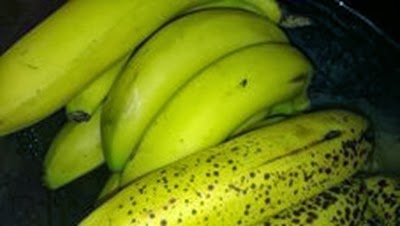
Bananas – variety Cavendish, which is a sub-group produced from a wild variety from Asia called ‘musa acuminata’ and the seedless ‘triploid’ (from three sets). This means that the Cavendish variety of banana is always cloned from a parent plant as it always produces seedless fruits.

Bananas in a bunch

Banana bunch

The most amazing sight is to see an ape take the skin off a banana for it removes it from the bottom blunt end pulling down towards the stem. This most likely is the correct way to peel the fruit as it takes off the ‘inner string’ or the correct name for this ‘Phloem Bundles’ that run from bottom to top of the fruit. A bunch of bananas when pulled off the plant is called ‘a hand.’

It is often found that if a person is allergic to latex they often cannot eat bananas.

The best bananas I have ever eaten are those grown in The Windward Islands: St Lucia, Dominica and St Vincent – all of these bananas are sweet, creamy textured, a milky rice pudding satisfying type of banana.

Never eat bananas early in the day if you have an important meeting as they make the tummy bloat and grow by several inches. They are also slow to digest and so a distended stomach may last for twelve hours or more. Bananas are best eaten in the evening when the body’s digestive system is working more quickly.

Words of wisdom from the old and wise:

“Bananas in the morning Catwalk dread; bananas in the evening beautifies the head.” Anon

Old bananas when they are slightly over-ripe may be peeled and chopped then frozen. Once frozen, mash them up or whizz them round in a food processor and they make a delicious and healthy ice-cream!

Crucifixion Thorn, Crucifix Thorn, Anchor Plant, Colletia Paradoxa

A few years ago whilst holidaying in Ireland I came across a most unusual plant. It had juicy leaves like a succulent. It was furnished with spines like a cactus. It was shaped in some places like thick vicious thorns in other areas it appeared to resemble a ship’s anchor. It was both soft and yet firm to the touch almost like a thick animal skin.

I later learnt that there are several types within the family or genus of Collectia. They all originate from South America and each variety has small white flowers when in bloom.


Crucifix Plan t- Crucifixion Plant - Anchor Plant

Crucifix Plan t- Crucifixion Plant - Anchor Plant - close

Crucifix Plan t- Crucifixion Plant - Anchor Plant - body of the shrub

Crucifix Plan t- Crucifixion Plant - Anchor Plant - body of the shrub close-up

The beautiful Crucifix Plant also known as the Crucifixion Plant or the Anchor Plant, which originates from South America and is part of the genus Collectia – they produce tiny white bell shaped flowers. This plant helps to enrich nitrogen in the soil where it grows.